
 1300 735 077

Plantation Shutters vs Curtains: Which Suits Melbourne Summer?
Alfresco Blinds Co
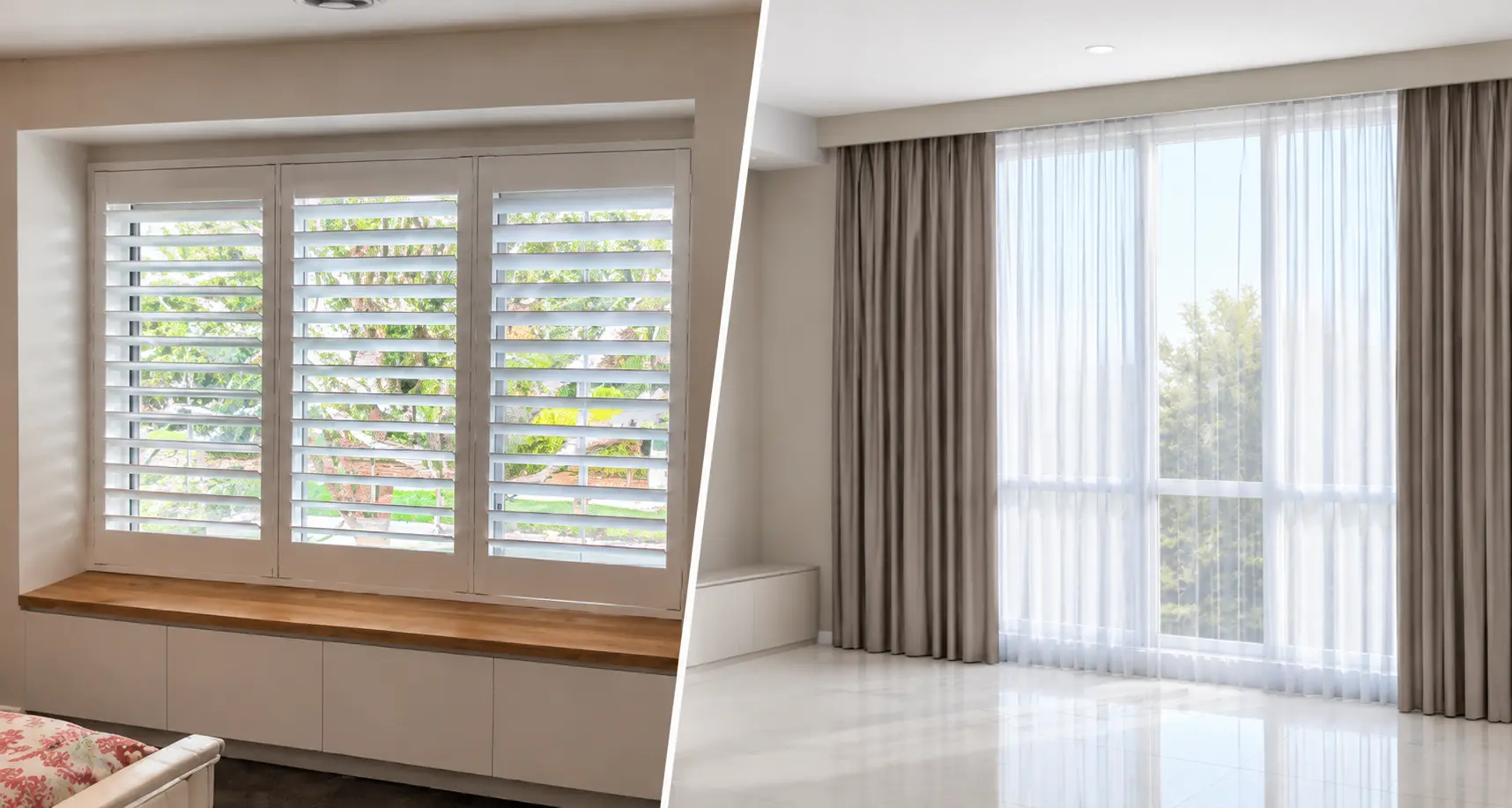
Plantation shutters are generally better for adjustable daylight, everyday privacy and easy cleaning, while curtains offer greater fabric choice, softer styling and potentially stronger room darkening and winter insulation when properly fitted. The right choice depends on your window size, budget, room layout and how you use the space.
Melbourne homeowners know how frustrating window furnishings can become when blazing summer afternoons are followed by chilly winter nights. This often leaves Melbourne homeowners confused about whether shutters or curtains will better suit their needs, leading them to choose an option based on looks or initial cost rather than its long-term comfort, functionality and suitability for their home.
Moreover, choosing any of the options without considering privacy, heating costs or everyday practicality is probably the biggest mistake. Shutters, on the one hand, offer adjustable louvres, while curtains, on the other hand, provide versatile fabric coverage. So, which delivers better value for your home: plantation shutters vs curtains? This guide compares their costs, seasonal performance and installation limitations, helping you make an informed choice before requesting a quote.
Plantation Shutters vs Curtains: Quick Comparison
Plantation shutters suit homeowners who prioritise adjustable privacy and a fitted appearance, while curtains are often preferable for bedrooms, large glass doors and flexible decorative styling.
However, neither option is automatically better for every Melbourne home.
| Feature | Plantation shutters | Curtains |
| Initial cost | Generally higher | Budget to premium |
| Daylight control | Adjustable louvres | Depends on fabric and opening position |
| Night-time privacy | Strong when properly closed | Strong with opaque or blockout fabric |
| Room darkening | Some light leakage is possible | Stronger with well-fitted blockout designs |
| Winter insulation | Depends on fit and design | Lined curtains with pelmets can perform well |
| Summer shading | Useful internal glare control | Useful internal glare control |
| Cleaning | Regular wiping or dusting | Vacuuming, washing or specialist cleaning |
| Sliding doors | Requires careful panel clearance | Often easier to accommodate |
| Style | Structured, architectural | Soft, flowing and versatile |
| Wet-area suitability | Suitable moisture-resistant shutters | Fabric selection and ventilation are critical |
The key is understanding which features matter most in each room, rather than installing one product throughout the entire house.
What’s the Difference Between Plantation Shutters and Curtains?
Plantation shutters are fitted panels with adjustable louvres, whereas curtains are fabric coverings that move along tracks or rods. This difference affects their appearance, daily operation and installation requirements.
Plantation shutters: Structured and adjustable
Plantation shutters are typically custom-made to fit a window opening. Their louvres can be tilted to regulate daylight, glare and visibility without opening the entire panel.
Common options include:
- Basswood shutters: A lightweight natural timber option suited to many living areas.
- Poplar timber shutters: A natural timber option that offers a smooth finish and can be customised to complement different interior styles.
- PVC shutters: Often chosen for humid environments when the particular product is rated for that use.
- Specialty shutter configurations: Hinged, tracked or shaped systems for suitable openings.
The main attraction is their integrated appearance. However, their frames and panels occupy physical space, so window depth and opening clearance matter.
Curtains: Flexible fabric coverage
Curtains are available in sheer, lined, blockout and decorative fabrics. They can be installed as a single layer or combined on separate tracks to meet different needs.
Popular choices include:
- Sheer curtains for softer daylight.
- Blockout curtains for privacy and room darkening.
- S-fold curtains for consistent waves and contemporary styling.
- Pinch-pleat curtains for a tailored finish.
- Motorised curtains for convenient operation.
- Double-track systems for daytime and evening flexibility.
For homeowners comparing curtains in Melbourne, the fabric, lining and installation details are just as important as the curtain style.
Shutters vs Curtains for Insulation: Which Works Better in Melbourne?
Well-fitted, lined curtains with pelmets can be particularly effective at reducing winter heat loss, while plantation shutters can also provide an additional barrier at the window. However, neither should be assumed superior without comparing the actual materials and installation.
Melbourne’s changeable conditions make this one of the most practical considerations for homeowners. A covering that reduces glare in January may not provide the warmth you need beside cold glass in July.
Which Performs Better During Melbourne Winters?
Window glass can be a significant source of heat loss, particularly in older homes with single glazing.
Heavy, closely woven curtains can help retain warmth when they fit properly around the window.
So, for better winter performance, consider:
- Thick or thermally lined curtain fabrics.
- Pelmets or enclosed curtain headings.
- Tracks that return towards the wall.
- Sufficient coverage at both window edges.
- Closing curtains when heating is operating.
These features help limit warm indoor air circulating behind the curtain and cooling against the glass.
Plantation shutters may also reduce unwanted heat transfer when their louvres and panels are closed. However, performance varies according to the frame, louvre construction and gaps around the installation.
A poorly fitted shutter should not be expected to outperform a carefully installed thermal curtain.
Which is better for Melbourne’s summer heat?
Neither internal shutters nor curtains should be treated as the most effective standalone defence against strong summer sun.
West-facing windows are particularly challenging because low-angle afternoon sunlight can enter when outdoor temperatures are already high.
Both options can help manage conditions:
- Plantation shutters: Tilt the louvres to reduce direct sunlight and glare.
- Blockout curtains: Close the fabric to reduce incoming light and improve visual comfort.
- Sheer curtains: Soften brightness while allowing some daylight through.
- External shading: Stop a significant proportion of solar radiation before it reaches the glass.
According to Sustainability Victoria’s guidance on reducing heat gain through windows, external shading is generally more effective than internal window coverings for reducing summer heat gain because it intercepts sunlight before it reaches the glazing. This is especially relevant for East and West-facing windows.
Other Options You May Consider
However, when internal shutters or curtains aren’t enough to manage harsh afternoon sunlight, exploring outdoor blinds for summer can help Melbourne homeowners find additional ways to reduce glare and solar heat before it enters their living spaces.
Similarly, comparing different types of awnings, such as pivot arm, drop arm and retractable designs, can help you identify suitable external shading for sun-exposed windows and adjoining outdoor areas.
What should Melbourne homeowners prioritise?
Your decision should reflect the conditions around each window:
- Cold south-facing bedrooms: Consider well-fitted thermal curtains with suitable edge coverage.
- Sunny north-facing living rooms: Choose a system that allows useful winter sunlight while managing summer glare.
- West-facing lounge windows: Assess external shading alongside the internal window covering.
- Street-facing rooms: Balance daylight, privacy and winter comfort instead of prioritising insulation alone.
The important distinction is that heating and cooling performance depends on the complete window system, not simply whether you choose shutters or curtains.
Which Offers Better Privacy and Light Control?
Plantation shutters usually provide more precise daytime privacy control through adjustable louvres, while opaque curtains provide straightforward visual screening when fully closed.
The difference becomes important in homes where windows face busy footpaths, shared driveways or neighbouring properties.
Daytime privacy: Plantation shutters have an advantage
With shutters, you can adjust the angle of the louvres while keeping the panels closed.
This can reduce direct views into a room without sacrificing all natural light.
They may be particularly useful for:
- Front-facing living rooms.
- Ground-floor home offices.
- Windows overlooking neighbouring properties.
- Dining rooms near shared outdoor spaces.
However, louvre angles are not a guarantee of complete privacy from every viewing position. Someone at a different height or angle may still see through the gaps.
Night-time privacy: Fabric selection matters
Opaque or blockout curtains can provide strong night-time privacy when closed and fitted appropriately.
Sheer curtains behave differently. When indoor lighting is brighter than the outdoors, silhouettes may remain visible through the fabric.
Therefore, for bedrooms and street-facing rooms, compare:
- Louvre closure and possible gaps around shutter panels.
- Curtain fabric opacity.
- Edge gaps around the covering.
- Lighting conditions after sunset.
- Whether a second layer is necessary.
Which option is better for complete darkness?
Well-fitted blockout curtains are generally more appropriate when a darker sleeping environment is the priority.
Shutters can reduce incoming light, but small gaps around panels or louvres may still allow light into the room.
For bedrooms and home theatres, examine the complete installation rather than assuming that a dark-coloured material guarantees total darkness.
What If Nothing Works?
If neither plantation shutters nor curtains meet your room-darkening needs, blockout blinds are another practical option, particularly for bedrooms and media rooms where controlling unwanted light is essential.
For even greater light control, cassette blockout blinds with properly fitted side channels can minimise light leakage around the edges, making them worth considering for shift workers, nurseries and home theatres.
Plantation Shutters vs Curtains: What Should You Budget?
Plantation shutters generally involve a higher initial investment than basic curtains, but premium custom curtains with linings, double tracks and motorisation can also become expensive.
The fairest comparison is between finished, professionally installed systems that meet the same functional requirements.
Indicative Melbourne and Victorian pricing
Published 2026 market guides suggest the following broad planning allowances:
| Window furnishing | Indicative cost per window |
| Plantation shutters, supplied and installed | 350–1,500+ |
| Curtains with track, supplied and installed | 250–1,000+ |
Note: These are broad third-party 2026 estimates in Australian dollars, not fixed quotations or guaranteed prices. They do not necessarily represent identical window sizes, specifications or installation scopes. Premium materials and complex installations may exceed these ranges.
What affects the price of plantation shutters?
Shutter quotations depend on considerably more than the visible window dimensions.
Common factors include:
- Timber, PVC or other shutter material.
- Total window area and panel dimensions.
- Louvre size and frame construction.
- Hinged, tracked or specialty configuration.
- Bay windows or unusual shapes.
- Recess depth and mounting requirements.
- Labour, site access and installation complexity.
A simple rectangular bedroom window will usually be easier to price than a wide glass opening requiring multiple tracked panels.
What affects the price of curtains?
Custom curtain pricing depends heavily on fabric consumption and hardware.
Consider:
- Window width and curtain drop.
- Fabric brand, composition and finish.
- Sheer versus lined or blockout material.
- Single versus double curtain tracks.
- Curtain fullness and heading style.
- Manual versus motorised operation.
- Installation and finishing requirements.
Remember, a premium double-layer curtain system may cost more than a basic shutter installation, so comparing starting prices alone can be misleading.
How can you compare quotes fairly?
Request two quotations based on the same window measurements and practical requirements.
Then check whether each includes:
- On-site measurement.
- Product supply and custom manufacturing.
- Tracks, rods, frames and fittings.
- Professional installation.
- GST and delivery.
- Warranty details and exclusions.
- Removal or disposal of existing coverings, if needed.
If thermal comfort or night-time privacy is essential, make sure each quote includes the necessary lining, blockout layer or other components.
Budget tip: Prioritise the rooms where the chosen product delivers the biggest practical benefit. You do not need to install plantation shutters or curtains throughout every room to achieve a consistent interior.
Shutters or Curtains for Bedrooms, Living Rooms and Sliding Doors?
The most practical choice changes according to the room’s size, purpose and window layout. A covering that works brilliantly on a bedroom window may be inconvenient across a frequently used sliding door.
Bedrooms: Curtains are often more versatile
Bedrooms usually require privacy, darkness and a comfortable atmosphere.
Well-fitted blockout curtains can meet these needs while allowing decorative fabric choices.
Consider curtains when you want:
- Reduced early-morning light.
- Softer interior styling.
- Full-length window coverage.
- Sheer and blockout layers.
- A potentially lower initial cost.
Plantation shutters can still work in bedrooms, especially where adjustable daytime privacy and a fitted appearance matter more than maximum darkness.
Living rooms: Either option can work
For traditional or Hamptons-inspired interiors, plantation shutters can create a structured architectural finish.
On the other hand, full-height curtains can soften hard surfaces and help visually connect large windows with the rest of the room.
Choose according to your priorities:
- Adjustable privacy: Consider plantation shutters.
- Soft decorative styling: Consider curtains.
- Large glass openings: Check curtain tracks and stacking space.
- Cold glazing: Compare thermal linings and installation fit.
- Strong afternoon glare: Assess additional shading requirements.
Sliding glass doors: Check access before choosing shutters
Large sliding doors create an installation challenge that is easy to overlook.
Plantation shutters may require tracked, bi-fold or other suitable panel arrangements. These systems need sufficient space for panels to move and stack without obstructing the door.
Curtains may be simpler because they move along a track and can be gathered to one or both sides.
Before choosing, check:
- The direction the glass door opens.
- The available space beside the opening.
- Whether the covering blocks a door handle.
- How frequently the door is used.
- Where shutter panels or curtain fabric will stack.
A properly designed shutter system can work on certain doors. However, it should not be selected without checking the complete opening arrangement.
Bathrooms and laundries: Material suitability matters
Suitable moisture-resistant plantation shutters may be a practical option for wet areas because their surfaces can generally be wiped clean.
Fabric curtains may be less convenient near showers, baths or sinks, particularly where ventilation is poor.
However, not every timber or composite shutter product is suitable for sustained moisture exposure. Confirm the manufacturer’s specification before ordering.
Heritage and period homes: Consider the architecture
Melbourne’s Federation, Edwardian and Victorian-style homes often have distinctive window proportions and decorative finishes.
Timber shutters can complement some of these features, while carefully selected curtains can add softness without permanently changing the visual character of the room. Most importantly, the window shape, existing architraves and interior style should guide the decision.
Which Is Easier to Clean and Maintain?
Plantation shutters are generally easier to wipe down during routine cleaning, while curtains need fabric-specific care.
For shutters, regular dusting and occasional gentle wiping may be sufficient. However, timber finishes and certain coatings need appropriate cleaning products.
Curtains may require:
- Gentle vacuuming with an upholstery attachment.
- Periodic dust removal.
- Washing only when the care label permits.
- Professional cleaning for delicate or lined fabrics.
- Inspection of curtain tracks and hooks.
If you have children, pets or a high-traffic living space, consider whether frequent contact with the material could lead to marks or damage.
Neither product is completely maintenance-free. Longevity also depends on manufacturing quality, daily use, sunlight exposure and proper care.
Can You Install Shutters and Curtains Together?
Yes. Plantation shutters and curtains can be used together when the window and surrounding wall provide sufficient clearance for both systems.
This combination offers adjustable daylight control alongside the softer appearance of fabric.
When does layering make sense?
Combining shutters and curtains may suit:
- Bedrooms needing additional darkness.
- Living rooms requiring adjustable daytime privacy.
- Period homes where decorative drapes complement fitted shutters.
- Windows where thermal curtains are useful during winter.
- Spaces where shutters alone appear too structured.
However, layering is not automatically the best choice.
The shutter panels must still be able to open properly, and the curtain track must not obstruct the window or make daily operation difficult.
For many homes, using shutters in selected rooms and curtains elsewhere may be more economical than installing both over the same window.
7 Checks Before Choosing Plantation Shutters or Curtains
Use this checklist before comparing final quotes.
1. Identify the room’s main purpose
If privacy and adjustable daylight are the priority, consider shutters, and if sleeping darkness and soft styling matter more, assess blockout curtains.
2. Check window orientation
North-, south-, east- and west-facing windows experience different sunlight conditions. Match the covering to both winter comfort and summer glare.
3. Measure available opening space
Check window depth, wall clearance, door handles and the space needed for shutter panels or curtain fabric to move.
4. Test privacy after sunset
Do not judge privacy using daylight alone. Inspect how the selected system performs with interior lights on.
5. Compare equivalent quotations
Ask for full supply-and-install prices for the same window and make sure you include linings, tracks, frames, accessories and installation.
6. Consider cleaning and durability
Choose a material compatible with your household, moisture exposure and maintenance preferences.
7. Decide whether a combination works better
You can use shutters in street-facing living areas and blockout curtains in bedrooms instead of choosing any one type for the entire home.
Decision rule: Choose the covering that solves the room’s biggest practical problem first, then compare style and cost between suitable options.
Frequently Asked Questions
Shutters are often better for adjustable daylight, everyday privacy and easy cleaning. Curtains, however, are generally better for decorative flexibility, wide windows and strong room darkening when blockout fabrics are properly fitted.
Blockout curtains are often a practical choice for bedrooms because they help reduce incoming light and provide privacy. Plantation shutters can also work well if you prefer adjustable daylight and a structured appearance. For better darkness, consider combining shutters with blockout curtains.
Plantation shutters generally have a higher upfront cost than basic curtains. However, custom curtains with premium fabrics, thermal linings, double tracks or motorisation can also be expensive. Compare complete supply-and-installation quotes to understand the actual cost.
Not necessarily. Well-fitted thermal curtains with pelmets can help reduce heat loss during winter. Plantation shutters also provide an additional barrier at windows, but their insulation performance depends on the materials, construction and installation. The type of window glazing also makes a difference.
No. Although closed plantation shutters reduce incoming light, small gaps around the louvres and frames can allow some light through. If complete or near-total room darkening is important, properly fitted blockout curtains or blinds are generally a more suitable option.
Yes. Curtains can be installed alongside plantation shutters if there is sufficient space for both systems to operate properly. This combination provides adjustable daylight control, additional privacy and a softer decorative finish.
Yes, some plantation shutter systems are designed for sliding or wide glass doors. However, the panel configuration, track position and stacking space must be planned to avoid restricting access.
Plantation shutters are generally easier to maintain with regular dusting and gentle wiping. Curtains, on the other hand, require cleaning methods appropriate to their fabric, and certain delicate or lined materials may need professional treatment.
Final Verdict: Plantation Shutters or Curtains for Your Melbourne Home?
Choosing between plantation shutters and curtains comes down to more than appearance. Your budget, privacy needs, window layout and seasonal comfort should determine which option works best.
For many Melbourne homes, a room-by-room combination is the most sensible approach:
- Consider shutters where adjustable privacy and architectural styling matter.
- Consider curtains for bedrooms, large openings and softer interiors.
- Assess external shading where summer heat gain is the major concern.
- Compare full installation quotes before committing.
The right decision is the one that suits your home throughout the year, not just how the window looks on installation day.
Still Deciding Between Plantation Shutters and Curtains?
With Melbourne’s hot summer afternoons and chilly winter evenings, choosing the wrong window furnishings can affect comfort, privacy and your renovation budget. That’s why comparing materials, fittings and real fabric samples before making a final decision is worthwhile.
Explore plantation shutters in Melbourne and custom curtains in Melbourne to understand your options and make an informed decision later on. Alternatively, you may browse curtains and blinds in Melbourne or request a free measure and quote to find a suitable solution for your windows.
 Previous


Follow Us on Instagram
