 1300 735 077
The Best Outdoor Blinds forMelbourne Homes
Alfresco Blinds Co
If you’ve spent a Melbourne summer trying to enjoy your alfresco while the westerly sun bakes your furniture and the afternoon cool change whips through at 40 km/h, you already know the problem. Outdoor blinds are the practical fix — and in 2026, they’re better looking and smarter than ever.
This guide covers everything you need to make a confident decision: the types available, what they cost, how much energy they save, and how to pick the right system for your home. Whether you’re upgrading a patio in Hawthorn or enclosing a pergola in Epping, we’ve got you sorted.
(Sustainability Victoria)
Why outdoor blinds matter in Melbourne
Melbourne’s weather is notoriously unpredictable — you can get all four seasons in one afternoon, particularly in spring and autumn. That variability is precisely what makes outdoor blinds such a sensible investment for local homeowners. Unlike inland Australian cities, Melbourne deals with harsh UV exposure in summer, cutting southerlies in winter, and blustering spring days that make outdoor dining feel more like a contact sport.
Beyond comfort, outdoor blinds have become a genuine property value driver. Well-designed alfresco spaces with quality blinds are a strong selling point in Melbourne’s competitive real estate market, with estate agents noting that functional outdoor living spaces attract buyer interest and can positively influence valuations.
The core benefits, broken down
What outdoor blinds actually do for your home
Types of outdoor blinds — compared
Not all outdoor blinds are the same. The right choice depends on how exposed your space is, how often you’ll use it, and your budget. Here’s a clear breakdown of the main systems you’ll find in Melbourne.
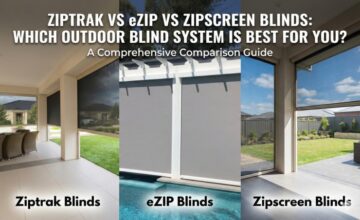
Ziptrak® Blinds
The gold standard for Melbourne alfresco areas. Spring-balanced zip guide system operates without a locking mechanism — just push up or pull down and it stays in place.
- ✔ No locking mechanism – smooth spring tension
- ✔ Excellent wind resistance (tested to 90+ km/h)
- ✔ Motorisation-ready
- ✔ Range of mesh, sunscreen and PVC fabrics
- ✔ Australian-made system
eZip Blinds
Zip-guided system with similar performance to Ziptrak. Available in motorised options and works well for wider openings where track-guided operation matters most.
- ✔ Zip guide eliminates side gaps
- ✔ Strong motorisation range
- ✔ Great for pergola and patio enclosures
- ✔ UV-resistant fabric options
PVC Café Blinds
Classic clear PVC gives full weather and wind protection while preserving your view. Very popular for enclosed entertaining areas, restaurants, and commercial spaces.
- ✔ Crystal-clear view through PVC
- ✔ Excellent wind and rain protection
- ✔ Easy to clean and maintain
- ✔ Available in tinted options
Quick comparison at a glance
| Feature | Ziptrak® | eZip | PVC Café | Mesh |
|---|---|---|---|---|
| Wind resistance | Excellent | Excellent | Excellent | Moderate |
| UV protection | ✓ High | ✓ High | Moderate | ✓ High |
| Airflow | Partial | Partial | None | Excellent |
| View-through | Fabric-dependent | Fabric-dependent | Full clear | Hazy |
| Motorisation | ✓ Available | ✓ Available | Limited | ✓ Available |
| Price point | Premium | Premium | Budget-friendly | Mid-range |
| Best for | Full alfresco enclosure | Wide openings | Restaurants, viewing | Summer ventilation |
Energy efficiency & UV protection
This is where the practical case for outdoor blinds gets genuinely compelling — especially given rising electricity costs across Victoria. The key principle is simple: blocking heat before it enters your home is far more effective than trying to cool a room after the sun has already heated it.
Studies show that up to 40% of a home’s heating and cooling energy can be lost through uncovered windows. Installing outdoor blinds on your most sun-exposed elevations — typically north and west-facing — tackles this at the source, keeping indoor temperatures significantly lower without running your air conditioner.
UV protection — not just about comfort
Melbourne’s UV index regularly reaches “Extreme” levels in summer, with UV radiation capable of causing skin damage even on cloudy days. Quality sunscreen fabrics in outdoor blinds can block up to 95% of UV rays while still admitting natural light — meaning you get the bright, open feel without the health risk or furniture fading.
Pricing guide for Melbourne — 2026
One of the most common questions we get is “how much do outdoor blinds actually cost?” The honest answer is that it depends — but here’s a genuine breakdown of what you should expect to pay in Melbourne for supply and professional installation.
What drives the cost up or down?
Opening width is the biggest variable — wider spans need more fabric and heavier-duty tracking. Drops over 2.5 metres also increase material requirements. Fabric choice matters too: marine-grade and UV-stabilised fabrics cost more upfront but outlast standard grades significantly. Motorisation adds roughly $500–$1,500 per blind but pays back in convenience and can be worth every dollar on blinds you’ll use daily.
Professional installation across Australia typically ranges from $250 to $800 per blind. In Melbourne specifically, expect mid-range installation costs given the cost of living and trade demand. DIY installation is possible for some systems, but track-guided blinds like Ziptrak really perform best when professionally measured and fitted.
Choosing blinds for Melbourne’s seasons
Melbourne’s four distinct seasons mean your outdoor blinds will earn their keep all year round — but the demands change with the weather. Here’s what to think about for each season.
Summer (Dec – Feb)
Priority: UV and heat blocking. Mesh or sunscreen fabrics let airflow in while cutting 70–95% of UV. Motorised systems shine here — you can lower blinds when the afternoon sun hits and raise them as it passes.
Autumn (Mar – May)
Melbourne’s most glorious season for outdoor entertaining. Light mesh blinds extend comfortable outdoor dining into the evenings as temperatures drop. A good time for installation — lead times are shorter and tradespeople more available.
Winter (Jun – Aug)
PVC café blinds come into their own here. They trap radiant heat from heaters in your alfresco, making enclosed outdoor spaces viable even on cold Melbourne nights. Great for winter barbecues or simply protecting furniture.
Spring (Sep – Nov)
Melbourne spring means strong northerlies and sudden cool changes. A track-guided blind rated to 90+ km/h wind resistance is invaluable. Spring is also peak installation season — book early to avoid waiting.
2026 trends: motorised & smart home blinds
If there’s one standout shift in the outdoor blind market heading into 2026, it’s the rapid uptake of motorised and smart home-integrated systems. What was once a luxury in high-end new builds is now a practical, affordable upgrade available across the full range of systems.
Motorised outdoor blinds can be controlled via remote, smartphone app, or integrated into smart home systems like Google Home or Amazon Alexa. Many advanced systems now include wind and sun sensors — they’ll automatically lower your blinds when the afternoon glare hits and retract them before a storm. That’s not just convenient; it also protects the fabric from storm damage.
Colour trends for 2026
The days of stark black-and-white patio blinds are giving way to warmer, more organic palettes. Soft beige, muted stone, charcoal, and warm grey are all gaining ground — hues that complement natural materials like timber decking and rattan furniture. In Melbourne, these neutral tones also coordinate well with the rendered and brick exteriors typical across the inner suburbs and outer east.
Minimalist design is also having a moment — concealed tracks, frameless finishes, and “invisible when retracted” headboxes are what buyers are asking for in 2026. The blind should enhance your home’s aesthetic, not dominate it.
How to choose — your step-by-step process
Don’t get overwhelmed. Here’s a practical process for narrowing down to the right blind for your Melbourne home.
Frequently asked questions
These are the questions we hear most often — both from homeowners doing their research and from the questions Melbourne people are asking AI assistants and Google in 2026.
The bottom line
Outdoor blinds are one of the highest-impact upgrades you can make to a Melbourne home. They extend your usable living space across all four seasons, cut your energy bills, protect your furniture from UV damage, and — when chosen well — genuinely improve your home’s street appeal and resale value.
The market has matured significantly by 2026. Motorised systems are accessible, smart home integration is mainstream, and fabric technology has never been better. Whether you’re after a no-fuss PVC café blind for a small balcony or a fully motorised, sensor-activated Ziptrak system for a large north-facing alfresco, there’s an excellent solution for your space and budget.
Alfresco Blinds Co has been helping Melbourne homeowners make this decision for over 35 years. We’re an authorised Ziptrak dealer based in Epping — come visit our showroom, or book a free measure and quote and we’ll come to you.
 Previous

Follow Us on Instagram
