 1300 735 077
Motorised Retractable Awnings: Are They Actually Worth It for Melbourne Homes in 2026?
Alfresco Blinds Co
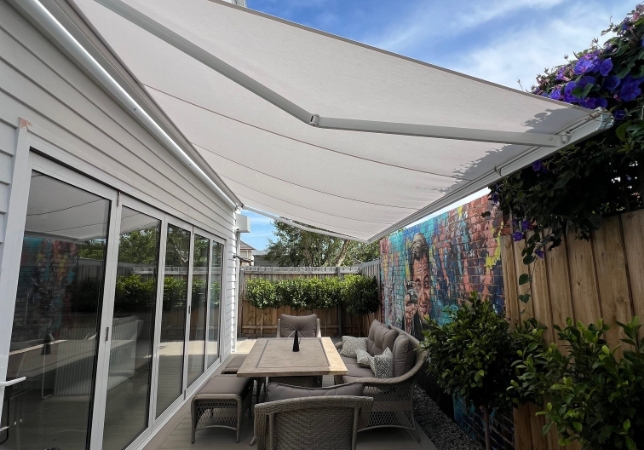
Motorised retractable awnings have shifted from a luxury feature to a practical outdoor living staple for many Melbourne homeowners. Melbourne’s notoriously unpredictable weather – blazing sun one hour, gusty south winds the next – makes a manually operated awning genuinely frustrating. Moreover, the gap in price between motorised and manual systems has narrowed considerably since 2022, making the upgrade far more accessible than most people assume.
So, the real question is not simply whether motorised awnings work. Instead, the question is whether they genuinely suit your outdoor space, your lifestyle, and your budget. This guide works through everything – from cost breakdowns and motor brand comparisons to wind sensors, smart home compatibility, and long-term maintenance. By the end, you will have a clear picture of what to expect before making any decisions.
Verified Fact – Source: Clean Energy Council Australia
Australia receives an average of 58 million petajoules of solar radiation annually, ranking among the highest globally. This directly supports the growing reliability of solar-powered awning motors in Australian climates, including Melbourne’s variable conditions.
Meanwhile, a growing number of Melbourne residents are integrating outdoor shading into broader smart home systems. Voice-controlled awnings, sun-tracking automation, and app-based scheduling are no longer features limited to high-end architectural builds. These capabilities are increasingly standard in mid-range motorised awning systems available today.
Alfresco Blinds Co has been working with Melbourne homeowners across these exact decisions for years. Their full range of awnings covers everything from motorised folding arm systems through to manual options, outdoor blinds, and complete smart outdoor setups. Their team is based locally at Epping and serves the wider Melbourne area with direct consultations and full installation support.
Motorised vs Manual: What Is the Real Difference for Melbourne Homeowners?
Understanding the core difference matters before investing. A manual retractable awning requires you to physically crank or push the awning in and out. A motorised retractable awning operates via an electric tubular motor housed inside the roller tube. You trigger it with a remote, a wall switch, a smartphone app, or an automated sensor.
Both types share the same fundamental fabric, frame, and folding arm mechanics. Therefore, the structural quality and material choice matter equally regardless of which operation type you choose. However, motorised systems add an extra layer of convenience – and for larger awnings covering wider spans, they also add a practical advantage. Manually winding a 6-metre awning repeatedly throughout a Melbourne summer becomes genuinely tiresome.
Where Manual Awnings Still Make Sense
Manual options are not inherently inferior. Smaller pergola awnings covering modest patio areas often work perfectly well without a motor. Additionally, properties with specific power access limitations or temporary installations may favour manual systems. However, for any awning wider than 3.5 metres, the motorised option typically pays for itself in daily convenience well within the first year of use.
| Feature | Manual Retractable Awning | Motorised Retractable Awning |
| Operation | Hand crank or manual push | Remote, app, voice, or sensor |
| Wind Response | Manual – must be home and aware | Automatic with wind sensor fitted |
| Typical Cost Premium | Base price | $800 to $1,500 more (mid-2026 estimate – verify with supplier) |
| Smart Home Compatible | No | Yes – most modern motors |
| Maintenance | Low – fewer components | Low to moderate – motor check every 2-3 years |
| Power Dependency | None | Yes – manual override available on most models |
Ultimately, the motorised option offers a level of daily usability that manual systems simply cannot match – particularly for households where residents have mobility limitations or where the awning is accessed multiple times per day.
“The best awning is one you actually use. A manual awning that stays retracted because extending it is inconvenient provides zero shade benefit and zero energy savings.” – Alfresco Blinds Co team
For further reading on what distinguishes different awning types, the Wikipedia entry on awnings provides a useful structural overview of retractable and folding arm designs from an architectural perspective.
What Does a Motorised Retractable Awning Actually Cost in Melbourne?
Pricing is where most online guides disappoint Melbourne homeowners. Figures quoted are often outdated, sourced from overseas markets, or based on minimum-size awnings that bear little resemblance to what most households actually need. Below is an honest overview of typical costs as of mid-2026, though prices vary based on size, fabric, motor brand, and installer. Always request a current quote directly from your supplier.
What Drives the Price Difference?
Several factors influence final motorised awning installation costs in Melbourne beyond the base unit price. First, arm span and fabric coverage directly affect structural requirements. Second, the motor brand and its ecosystem compatibility determine the electronics cost. Third, installation complexity – including wall type, height, and power routing – affects labour charges.
Furthermore, cassette-style awnings that fully enclose the retracted fabric command a higher price than open-roll versions, due to the additional housing components. However, the cassette design significantly extends fabric life by protecting it from UV, bird droppings, and Melbourne’s eucalypt debris when retracted.
- Awning arm span and fabric coverage area
- Motor brand and smart home ecosystem compatibility
- Cassette housing versus open roll design
- Wall or roof mounting complexity and height
- Power source routing – mains versus solar
- Addition of wind, sun, or rain sensors
- Fabric weight, UV rating, and colour selection
Alfresco Blinds Co provides transparent, itemised quotes across their folding arm awning range. Their team can clarify exactly which cost factors apply to your specific property and patio configuration before any commitment is made.
Folding Arm Awning Motor Options: Making the Right Choice
Not all motors are equal. Choosing the right motor for a retractable awning involves balancing torque ratings, cycle life, connectivity, and warranty support. For Melbourne homeowners, after-sales support availability in Australia matters just as much as the specification sheet.
Somfy: The Industry Standard in Australia
Somfy remains the most widely specified motor brand for motorised retractable awnings across Australia. Their RTS (Radio Technology Somfy) range provides reliable wireless control, while the io-homecontrol protocol enables deep smart home integration. Additionally, Somfy has established local service and distribution networks in Australia, making parts and support genuinely accessible.
Somfy motors are rated by torque (measured in Nm) and cycle count. Residential awning applications typically require between 30 Nm and 50 Nm depending on awning size and fabric weight. Their Sonesse and Ilmo motor series are particularly well-regarded for quiet operation – relevant if the awning is adjacent to bedrooms or living areas where motor noise would be intrusive.
Alternative Motor Brands Worth Knowing
Beyond Somfy, brands such as Nice and Dooya offer competitive motor options at various price points. Nice has grown its Australian market presence notably since 2022, offering strong integration with smart home ecosystems. Dooya supplies the OEM motors fitted in many mid-range awning systems sold under various brand names in Australia.
When comparing motor options, focus on three practical criteria: torque rating matched to your awning size, protocol compatibility with your preferred smart home system, and the availability of Australian-based warranty service. A motor with excellent specifications but no local service support creates a significant risk post-installation.
Verified Fact – Source: Somfy Australia Product Specifications
Somfy tubular motors for external awning applications carry IP44 or higher ingress protection ratings, meaning they are tested to resist dust particles and water splashing from any direction. This is particularly relevant for Melbourne’s autumn rain events and coastal-adjacent properties.
Tubular Motor vs Direct Drive: What Is the Difference?
Most retractable awnings use a tubular motor – a cylindrical motor inserted directly into the awning’s roller tube. This design is compact, weather-resistant, and quiet. Direct drive motors are less common in residential retractable awnings but appear in some larger commercial shade systems.
For standard residential folding arm awnings across Melbourne, a quality tubular motor with appropriate torque and IP rating is the correct choice in almost every case. Consult your installer if your awning span exceeds 7 metres or if you are specifying a dual-motor setup for extra-wide coverage.
Wind Sensors and Automatic Weather Response in Melbourne
A retractable awning wind sensor in Melbourne is arguably one of the most practical additions available. Melbourne’s weather is genuinely changeable – the Bureau of Meteorology consistently records rapid wind speed increases, particularly during spring and late summer storm activity. An awning left extended during a sudden squall risks significant fabric and frame damage.
A wind sensor mounted near the awning continuously monitors wind speed. When gusts exceed the preset threshold – typically between 35 and 50 km/h – the motor triggers automatically and retracts the awning before damage can occur. This happens regardless of whether you are home, awake, or paying attention to the weather. Consequently, wind sensors are not merely convenient; they are a meaningful form of asset protection.
How Wind Sensor Calibration Affects Daily Use
Calibration matters more than most homeowners initially realise. A sensor set too sensitively will retract the awning on light sea breezes that pose no real risk, reducing usability during pleasant afternoons. Conversely, a threshold set too high may not trigger retraction quickly enough during fast-developing storm conditions.
Most quality sensors allow the threshold to be adjusted post-installation. Discuss this calibration process with your installer before commissioning. Furthermore, the sensor’s mounting position affects performance. A sensor mounted too close to building surfaces may read lower wind speeds than the awning actually experiences at its extended position.
Sun and Rain Sensors: The Full Automation Picture
Beyond wind detection, sun sensors can trigger the awning to extend automatically when solar radiation exceeds a preset lux level – effectively creating a shade system that responds to the sun rather than relying on manual operation. Rain sensors perform the reverse role, retracting the awning during wet weather to protect fabric and prevent pooling.
The combination of wind, sun, and rain sensors creates a genuinely autonomous outdoor shading system. For Melbourne properties where the outdoor space is used daily throughout summer, this level of automation dramatically increases the practical value of the installation. Alfresco Blinds Co can advise which sensor configurations suit your specific property setup across their smart outdoor systems range.
Smart Home Awning Automation: Alexa, Google Home, and Beyond
Smart home awning automation has matured significantly since 2022. Modern motorised retractable awning systems using Somfy’s io-homecontrol or RTS protocols integrate directly with Amazon Alexa, Google Home, and Apple HomeKit. This means you can extend or retract your awning using a voice command, a smartphone app, or a preset automation schedule – without being in visual range of the awning itself.
Practical automation scenarios that Melbourne homeowners are using include scheduling the awning to extend automatically at 10:00 AM on weekdays, retracting at sunset, or linking awning behaviour to a smart thermostat that detects indoor temperature rise. These integrations reduce the mental load of managing outdoor comfort throughout the day.
Choosing a Motor Protocol for Your Smart Home
Protocol compatibility is the most important technical decision when combining a motorised awning with an existing smart home setup. The three primary protocols relevant to Australian installations are:
- Somfy RTS – One-way radio protocol. Works reliably with dedicated Somfy remotes and most smart home hubs via bridge accessories such as the Somfy TaHoma Switch.
- Somfy io-homecontrol – Two-way protocol providing confirmation feedback. Integrates natively with TaHoma, Apple HomeKit, and various home automation platforms.
- Z-Wave / Zigbee compatible motors – Less common in awning applications but supported by some newer motor models. Works well with Samsung SmartThings, Home Assistant, and similar platforms.
If you already have an established smart home ecosystem, confirm protocol compatibility before selecting your motor. Retrofitting a different protocol later typically requires motor replacement rather than simple reprogramming.
For homeowners building a broader connected outdoor space, combining motorised awnings with motorised outdoor blinds allows for comprehensive shade and privacy control from a single app or voice interface. This approach creates a cohesive outdoor living environment rather than a collection of separately operated products.
Power Outages and Motorised Awnings: What Actually Happens?
This concern comes up consistently among Melbourne homeowners considering the motorised upgrade. The short answer is reassuring: almost all quality motorised retractable awnings include a mechanical manual override. This is typically a small crank or hex key socket on the motor shaft, accessible from the awning body.
During a power outage, you disengage the motor using the override and then crank the awning in or out manually. The process takes roughly the same effort as operating a manual awning. It is not a seamless experience, but it is reliable and straightforward. The override mechanism is a standard safety feature rather than an afterthought on any reputable motor system.
Battery Backup Options
Some motorised awning systems support an optional battery backup module. These modules maintain motor operation for a limited number of cycles during a power outage without requiring manual intervention. However, battery backup modules add cost and require periodic battery maintenance or replacement.
For most Melbourne residential installations, the standard manual override is sufficient. Battery backup is more commonly specified in commercial settings or for properties with frequent power interruptions. Discuss this with your installer if uninterrupted automated operation during outages is a priority for your situation.
Solar-Powered Awning Motors: Are They Practical in Melbourne?
Solar-powered awning motors eliminate the need for mains wiring to the awning unit. This is genuinely useful for installations where running power cabling is impractical, expensive, or visually intrusive. The motor is powered by a small solar panel – typically 5W to 10W – combined with a rechargeable lithium battery that stores charge for operation during low-light periods.
In Melbourne’s climate, solar motors perform well throughout spring, summer, and autumn. Winter performance depends on panel orientation and shading from surrounding structures. A north-facing panel in full sun charges effectively even on Melbourne’s overcast winter days, though charge accumulation is slower than in summer months.
When Solar Makes Sense – and When It Doesn’t
Solar is well-suited to awnings that operate 3 to 8 times daily in typical summer use. High-frequency operation – such as an awning extended and retracted 15 or more times per day – may exceed what a standard solar module can replenish overnight during winter. In those cases, mains power remains more dependable.
Furthermore, solar motors typically cannot be integrated into the same smart home automation systems as their mains-powered counterparts without additional hardware. If smart home compatibility is a priority, confirm solar motor compatibility with your chosen platform before committing.
Verified Fact – Source: Australian Government – Your Home Energy Guide
Melbourne receives an average of 4.9 peak sun hours per day across the full year. In winter months (June to August), this drops to approximately 2.5 to 3.0 peak sun hours. Solar motor systems must be sized appropriately for winter operational demands to ensure year-round reliability.
Motorised Retractable Awning Maintenance: What You Actually Need to Do
One of the most common misconceptions about motorised awnings is that they require complex or frequent servicing. In practice, a quality installation requires relatively minimal maintenance when used correctly. However, neglecting basic care does shorten both fabric and motor lifespan – so understanding what to do and when is worth the time.
Routine Owner Maintenance Tasks
- Clean the fabric with mild soapy water and a soft brush 1 to 2 times per year
- Allow the fabric to dry fully before retracting – never retract while wet or damp
- Inspect arm joints and pivot points annually for early signs of rust or wear
- Clear debris from the roller tube and cassette housing after storms
- Check remote control batteries and motor response annually
- Retract the awning during storms, even with a wind sensor fitted, as a precaution
Professional Servicing Schedule
A professional service inspection every 2 to 3 years is generally appropriate for residential motorised awnings. During a service, a technician checks motor torque calibration, limit settings (the programmed stop points for extension and retraction), lubrication of arm joints, and fabric tension. Catching minor wear at service stage prevents more expensive component replacement later.
Motor units rated for higher cycle counts naturally outlast budget alternatives. As noted earlier, quality tubular motors typically achieve 10 to 15 years of service life under normal residential conditions. However, exposure to salt air in bayside Melbourne suburbs can accelerate component wear, making annual inspections – rather than biennial ones – more appropriate for those locations.
A retracted awning is a protected awning. The single most effective maintenance habit is developing a routine of retracting the awning when the outdoor space is not in active use – particularly overnight and during unsettled weather.
For ongoing maintenance and servicing questions, Alfresco Blinds Co is available Monday to Friday from 9:00 AM to 4:30 PM, with Saturday appointments available. Their contact details are listed below.
Frequently Asked Questions About Motorised Retractable Awnings
Are motorised retractable awnings actually worth the extra cost?
Yes, for most Melbourne homeowners they are. The combination of convenience, automatic weather protection, and smart home integration delivers real long-term value. The price premium over manual systems has also reduced since 2022. The break-even point in usability is typically within the first year for awnings covering frequently used outdoor spaces.
How much does it cost to motorise an existing manual awning?
Retrofitting a compatible manual awning with a motor typically costs between $600 and $1,200 in Melbourne as of mid-2026, depending on the motor brand, awning size, and installation complexity. Not all manual awnings are compatible with retrofit motors, so a professional assessment is essential before committing to this approach. Prices vary – always request a current quote.
What happens to a motorised awning during a power outage?
Most motorised retractable awnings include a mechanical manual override – typically a hex key crank socket on the motor shaft. This allows manual extension or retraction during a power outage. Some premium motor systems also support optional battery backup modules for automated operation during outages, though these add cost and maintenance requirements.
Do motorised awnings retract automatically in strong wind?
Only if a compatible wind sensor is fitted and properly calibrated. Without a sensor, the motor responds only to remote, switch, or app commands. With a wind sensor, the awning retracts automatically when gusts exceed the preset threshold – typically between 35 and 50 km/h – regardless of whether you are home.
Can I add a wind sensor to my awning after installation?
In most cases, yes. If the motor is compatible with external sensor accessories – as most Somfy motors are – a wind sensor can be added post-installation without replacing the motor. Confirm compatibility with your installer before purchasing a sensor separately.
Are Somfy motors better than other retractable awning motor brands?
Somfy leads the Australian market in ecosystem depth, smart home compatibility, and local service availability. They are widely regarded as the industry benchmark for quality and reliability. Other reputable options include Nice and Dooya. The best choice depends on your smart home platform, budget, and how important local after-sales support is to you.
How long do motorised awning motors typically last before needing repair?
Quality tubular motors in residential retractable awnings typically last 10 to 15 years under normal use. Bayside Melbourne properties, exposure to salt air, or very high-frequency operation may reduce this. Regular servicing every 2 to 3 years helps identify wear early and extend motor lifespan.
Can motorised retractable awnings be controlled with Alexa or Google Home?
Yes. Motors using Somfy io-homecontrol or the TaHoma bridge integrate directly with Amazon Alexa, Google Home, and Apple HomeKit. This allows voice commands, app control, and automation routines through your existing smart home setup. Confirm protocol compatibility at purchase stage.
Is a solar-powered awning motor reliable through a Melbourne winter?
Solar motors can work year-round in Melbourne, but winter reliability depends on panel orientation, shading, and daily operation frequency. Melbourne receives approximately 2.5 to 3.0 peak sun hours per day in winter months. Most solar motor systems include a battery buffer to maintain operation during overcast periods, but high daily usage in winter may require supplemental charging or a mains alternative.
What’s the real difference between a folding arm awning and a retractable awning?
A folding arm awning is a specific type of retractable awning that uses articulated arms to extend and support the fabric canopy without vertical posts. The term retractable awning is broader and includes cassette awnings and other designs. Folding arm awnings are particularly suited to balconies, elevated decks, and patios where post installation is not practical.
How often should I service my motorised awning?
A professional service inspection every 2 to 3 years is appropriate for most Melbourne residential installations. Between services, inspect arm joints and fabric annually, clean the fabric 1 to 2 times per year, and retract the awning during storms. Bayside or high-wind-exposure properties may benefit from annual professional inspections.
Does wind sensor sensitivity affect the awning’s daily usability?
Yes, significantly. A sensor calibrated too sensitively may retract the awning on mild breezes that pose no structural risk, reducing comfort during pleasant afternoons. Most quality sensors allow threshold adjustment. Discuss calibration options with your installer to find a balance between protection and daily usability for your specific location.
Do motorised awnings add value to a Melbourne home?
Generally yes, though specific value uplift figures vary by property and market conditions. Quality external shading – particularly motorised systems with automation features – is consistently regarded as a desirable feature in Melbourne’s real estate market, where outdoor living areas are central to property value. A well-specified, professionally installed motorised awning contributes to both liveability and presentation.
The Bottom Line on Motorised Retractable Awnings for Melbourne Homes
Motorised retractable awnings represent a genuine quality-of-life upgrade for Melbourne homeowners who use their outdoor spaces regularly. The convenience of one-touch or automated operation, combined with wind sensor protection and smart home integration, makes them significantly more practical than manual alternatives – especially for larger awnings or households where daily manual adjustment is impractical.
The cost premium over manual systems is real but manageable. Additionally, the factors that drive cost – motor brand, awning size, sensor additions, and installation complexity – are all negotiable and configurable to suit different budgets. The key is getting an accurate, current quote from a reputable Melbourne installer rather than relying on generic online price guides.
Furthermore, the long-term economics are favourable. A quality motorised system with proper maintenance lasts well over a decade. Meanwhile, the energy savings from effective external shading – reducing indoor heat gain during Melbourne summers – contribute to reduced cooling costs over time. The Australian Government’s energy efficiency resources consistently identify external shading as one of the most cost-effective passive cooling strategies for Australian homes.
If you are considering motorised retractable awnings in Melbourne, the next step is straightforward. Speak to the team at Alfresco Blinds Co. They will assess your space, walk you through motor and sensor options, and provide a written quote with no obligation to proceed. The process is genuinely simple when you work with people who know what they are doing.
 Previous

Follow Us on Instagram
